.
Feedback

Is Gov. Brown Right to Dole Out Money to Schools Unequally?

Compare per student funding for Alameda, Albany, Berkeley, Oakland, Piedmont and West Contra Costa schools.

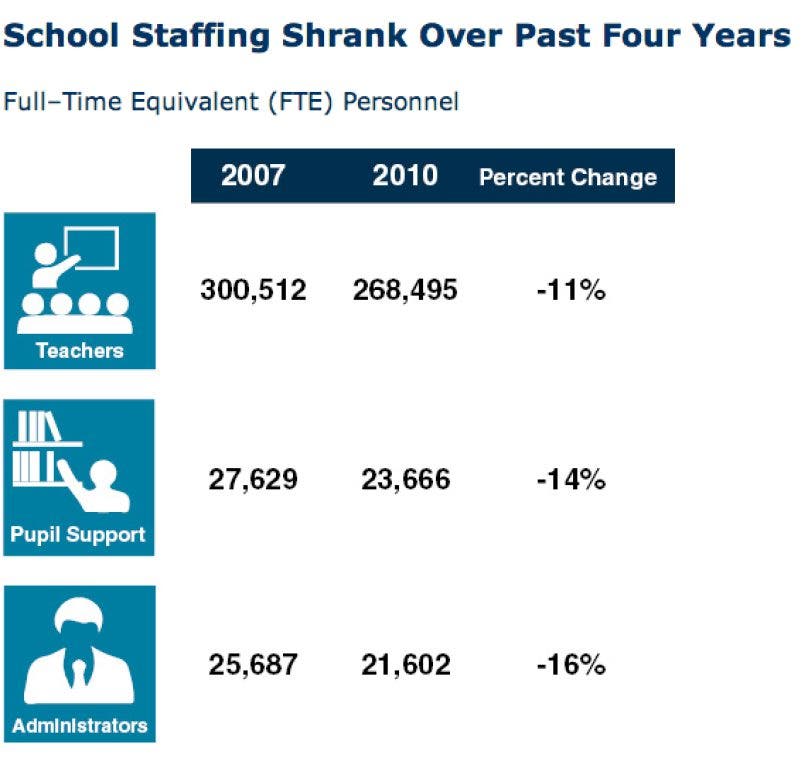
This is what California public education looks like after the Great Recession: 

Between 2007 and 2010, the number of teachers in the state's K-12 classrooms shrunk by 11 percent. Reading specialists, librarians, and other school employees helping students learn declined by 14 percent. Front offices took the hardest blow, with the number of administrators dropping by 16 percent. All these cuts hit schools even as the total enrollment held steady at around 6.2 million students. 

Now that California is looking at its first budget without a deficit in five years, Gov. Jerry Brown's budget calls for restoring some money to the state's public schools. But, he does not want to distribute the money equally.

[For differences in revenues between Alameda, Albany, Berkeley, Oakland, Piedmont and WCC unified school districts during the 2010-11 school year, see the tables at the bottom of this article.]

"Aristotle said, 'Treating unequals equally is not justice.' And people are in different situations. Growing up in Compton or Richmond is not like it is to grow up in Los Gatos or Beverly Hills or Piedmont," Brown said, according to the San Francisco Chronicle.

There are already big differences in the sums school districts get from the state.

Consider two communities Brown mentioned, Piedmont and Richmond. In the 2010-11 school year, Piedmont received $12,287 for every student. The West Contra Costa Unified School District, which includes Richmond, received $9,735 per student.

But only $3,300 of Piedmont’s revenue came from the state. That’s about a third less than the average unified school district gets from Sacramento. Contra Costa Unified School District received $5,600 per student from the state, which is more than the statewide average.

Here’s how Piedmont made up the difference and then some: The $9.1 million that Piedmont raised that school year in parcel taxes was 7,589 percent higher than the statewide average.

Brown’s spending plan has a $3 billion more than last year for K-12 and community colleges, will that be enough to bridge the economic gap that contributes to the achievement gap, and ultimately becomes a cycle-reinforcing income gap? Does more money improve student performance? 

Alameda USD Revenue for 2010-11 Source $ Amount per student % Statewide average for unified school districts State Aid $3,306 96% Local Property Taxes $2,009 103% Federal Revenue $737 66% Other State Revenue $1,469 74% Other Local Revenue (includes parcel taxes) $1,868 351% Total $9,390 104%

Albany USD Revenue for 2010-11

Source $ Amount per student % Statewide average for unified school districts State Aid $3,678 107% Local Property Taxes $1,607 83% Federal Revenue $2,058 185% Other State Revenue $4,657 233% Other Local Revenue (includes parcel taxes) $1,891 356% Total $13,891 154% Berkeley USD Revenue for 2010-11 Source $ Amount per student % Statewide average for unified school districts State Aid $2,565 75% Local Property Taxes $2,993 154% Federal Revenue $728 65% Other State Revenue $2,439 122% Other Local Revenue (includes parcel taxes) $4,344 817% Total $13,070 145% Oakland USD Revenue for 2010-2011 Source $ Amount per student % Statewide average for unified school district State Aid $3,564 104% Local Property Taxes $1,806 93% Federal Revenue $1,833 164% Other State Revenue $3,373 169% Other Local Revenue (includes parcel taxes) $1,119 210% Total $11,695 130% Piedmont USD Revenue for 2010-11 Source  $ Amount per student % Statewide average for unified school districts State Aid $2,300 67% Local Property Taxes $3,029 156% Federal Revenue $504 45% Other State Revenue $1,024 51% Other Local Revenue (includes parcel taxes) $5,430 1,021% Total $12,287

136%

West Contra Costa Revenue for 2010-11 Source $ Amount per student % Statewide average for unified school districts State Aid $3,340 97% Local Property Taxes $2,063 106% Federal Revenue $1,196 107% Other State Revenue $2,333 117% Other Local Revenue (includes parcel taxes) $804 151% Total $9,735 108%

Source: California Department of Education, Ed-Data

Bart Grossman January 13, 2013 at 03:45 pm
There should be a dependable minimum that all districts receive otherwise the state will use parcel taxes as a way to constantly decrease its contribution. That will make it harder to pass parcel taxes in the future. If the state contributes more to districts with greater need it should be done in terms of specific programs, not as a blank check. The blank check model is a formula for corruption.
SalthePlumber January 13, 2013 at 03:59 pm
If Prop 13 is Constitutional, then I guess the Governor can spend school dollars on his own Curve. Taxing LIKE properties that sit side by side, at different rates, doesnt seem Constitutional, never did. Maybe its time for the Feds and the States to do some Spring Cleaning in the Revenue Collection Dept...
Alex Gronke (Editor) January 13, 2013 at 04:26 pm
Thanks Rick, the article didn't compare Berkeley's local revenue to Piedmont's. It compared both to the statewide average for unified school districts. But, you are right. Both parcel taxes and education finance are complex subjects. Put them together and it's insanely complicated. For people looking to better understand how schools get money, EdSource is a good place to start. http://www.edsource.org/school-finance.html
Ross Stapleton-Gray January 13, 2013 at 05:31 pm
I'm a big fan of the government doing what it can to eliminate insidious inequity, where it can be most cost effective. This isn't "tax everyone so no one gets ahead," but "spend some of our collective dollars where the worst problems are most readily addressed." And education (including school lunch subsidy, where you can address one of the worst effects of poverty: hunger/poor nutrition eroding the ability to learn) does seem like a good "bang for the buck" investment area.
Local Mom January 13, 2013 at 06:18 pm
Just think about what private schools charge for one year of elementary school ($18-20K) and you can see how shortchanged public schools are. YES I am cautiously optimistic that the new funding formula will be good news for WCCUSD and its students.
Susan D.Keeffe January 13, 2013 at 06:24 pm
The headline is very misleading, Brown doesn't personally "dole"out anything. He inherited a complex education financial structure burdened with bureaucratic rules and regulations not of his making . He may be the first governor to show a willingness to tackle this head on, it's a huge mess. I applaud his willingness to open the conversation. I hope the legislature is willing to tackle it.
Denise Sangster January 13, 2013 at 06:47 pm
I am curious why Albany received significantly more in three categories: State Aid, Federal Revenue, and Other State Revenue. Does anyone have an explanation? [Total the three categories (State Aid, Federal Revenue, and Other State Revenue) for each school district, above, and Albany is significantly higher. Anyone know why?)
Michael of Richmond January 13, 2013 at 06:58 pm
I think WCCSD and others with out resources, should get even more of the pie. We need parity and the ability of some schools to raise money In wealthier districts also increases the gap. Public education should be, dollar for dollar, as close to fair as possible. How is a kid in a central Richmond school ever going to have the same chance unless we find a way to level the playing field. Our youth have little control over where they live or thier circumstances. They need support and as much as we can do to provide an equal environment for learning.
tim west January 13, 2013 at 07:46 pm
Anybody out there understand the line item "other state revenue" there is a huge inequity in that area between these neighboring districts. It would be fine if the totals from all sources added up to close to the same per student- but West Contra Costa and Alameda are about $3,000 per year lower than the rest....
Susan D.Keeffe January 13, 2013 at 08:14 pm
I think "other" refers to local fund raisers, donations and miscellaneous grants districts apply for.
Bart Grossman January 13, 2013 at 08:29 pm
In terms of state funding I know that Albany gets extra funding because Albany Village is University property and does not pay taxes to the school district.
Bart Grossman January 13, 2013 at 08:38 pm
The problem with previous efforts to achieve equity like Serrano vs. Priest is that it was done by penalizing districts that had high tax bases rather than supplementing districts with low taxes. Since California has an embarrassingly low rate of per pupil expenditure to begin with, we need to level up not down.
Ira Sharenow January 13, 2013 at 11:32 pm
Albany received a large amount of state pass through money which was just passed along to another entity. It is not clear that Albany still receives extra money from the state because of University Village. The superintendent could not confirm that when I asked her.
One reason, at least in some districts, why the number of teachers declined during the economic downturn is that employee compensation continued to outpace inflation. Many Alameda County districts, such as Alameda and Albany, spend more per student than the state average. WCCUSD receives and spends way more than the state average (and this is before the new taxes are included), but the district spends an unusually large amount of money on construction projects. http://www.ed-data.k12.ca.us/App_Resx/EdDataClassic/fsTwoPanel.aspx?#!bottom=/_layouts/EdDataClassic/finance/MC-FinanceResults.asp
David January 14, 2013 at 12:08 am
California spends $11,455 per K-12 public school pupil on average.
What's embarrassing is what little we get for such massive expenditures. Take a look for yourself, under K-12 education: http://www.ebudget.ca.gov/BudgetSummary/BSS/BSS.html
Marsha Skinner January 14, 2013 at 12:38 am
Many years ago, Albany got an additional allocation because of the Village When the State changed to the current " Average Daily Attendance" dollar figure, that, and the local property tax rate we were charging at that time, were folded into the " Average Daily Attendance" $ formula Since then , there has been at least one round of state " equalization" payments to bring up the lower funded districts, which have diluted the additional money we once got, since we did not receive the equalization payments We no longer receive anything specifically identifiable as being for the Village .
My personal guess , I've been blissfully out of this business for some time, is that this reflects the additional payments for Special Education students . Albany administered the "SELPA". Much of this is shown as Albany revenue, but is then really passed through to other Districts as they perform services . Although new " out of District" students have been allowed in in a reduced percentage in comparison to prior years, Albany still has a very large number of students attending who do not reside in Albany. I'd suggest that the fairest possible allocation would consider the STUDENTS, and provide additional funding for each student receiving free or reduced price lunch, each student needing services as a English language learner, each student needing other kinds of special services, rather than characterizing an individual district as one way or another.
Rick Schiller January 14, 2013 at 02:03 am
Alex, Yes very complex and meaningful comparisons are difficult to come by. I zeroed in on the Parcel tax as one of the few apples to apples comparisons. EdSource is an excellent reference and Editor John Fensterwald has been involved in this arena for some time. Another good source is http://www.csba.org/ the California School Boards Association.
Fran Anderson January 14, 2013 at 04:06 am
I've met Gov. Brown & his father & followed the younger most of his political career. He's been across the state & is quite familiar with the disparities of resources that have plagued certain school districts. I have complete faith in his judgement & wisdom as I do with that of our President, and that's saying a lot, from me.
Michael O'Connor January 14, 2013 at 12:28 pm
The straw man has returned. Funding for school construction is not in any way connected to school operational expenditures. If an unenligtened majority allows the district infrastructure to deteriorate over many decades, righting that misstep becomes a very expensive proposition.
Alex Gronke (Editor) January 14, 2013 at 12:39 pm
George Skelton, the LA Times' Sacramento columnist, came out against Brown's funding plan for schools Monday. The kicker: "Brown's right. Paul needs more money. But he's wrong to mug Peter." http://www.latimes.com/news/local/la-me-cap-budget-20130114,0,2017690.column
David January 14, 2013 at 12:49 pm
Spending per pupil has increased massively (+80%, inflation-adjusted) since Prop 13. Outcomes have only worsened. I take issue with "Paul needing more money."
The schools don't need more money. They need to be run like successful schools. Which schools are these? High-performing inner city Catholic and charter schools, who by the way, educate their pupils for less money than the state and cities throw at public schools.
Jon Spangler January 14, 2013 at 01:23 pm
I'm not one of the three people in California who fully understand the intricacies of school funding. But I do understand enough about it to know that our schools are significantly underfunded and that we need to reform and reallocate this byzantine and unfair system. Good for Governor Brown for at least putting forth a proposal to start the discussion.
David January 14, 2013 at 02:53 pm
The state is spending 8% more per pupil this year to $11,455 from $10,653.
Median private sector raise for 2012 is 1.8%, nationwide (I doubt it's much more in California). Underfunded? Not really. Misallocated? Certainly, but not because of rich/poor districts; because we're diverting $3.5B of the recent "increase" in school spending to...pensions and retiree health care--it'll never see the classroom. As for the 'byzantine' system, yes. How about we solve it by taking that $11,455 and just allocating it per student. If the parents are happy with the local public school, it goes there. If they want to send their pupil to a private school, it pays the tuition up to that point. (actually it'd be more like $9,000 for K-8 and $15,000 for high school). And actually it'd end up being even more than that, since we'd get to lay off a good chunk of the 2.865 million state administrators, and could reallocate the bureaucrats' salaries to student funding.
Jim Wright January 14, 2013 at 05:27 pm
The politics of equality/inequality aside, the brute fact is that Alameda schools need more revenue.
Michael John Torrey January 14, 2013 at 06:04 pm
To: The Alameda Patch
From: Michael John Torrey RE: Jerry Brown's Fairness In Allocations To The Unified School Districts concerning your query of the Honorable Jerry Brown's fairness in fund allocations to the Unified School Districts. I think you have to first look at the total number of students a School District has, then you have to look at the number of Students each campus in the district has Then you have to multiply that number times the total amount of the Average Daily Attendance (A.D.A.) allowance. Once you've done the arithmetic then you ask your self if Jerry Brown's allocation to each School District is done in fairness.
Dawn January 14, 2013 at 07:47 pm
I have a HUGE problem with sending any govt money to private schools. They are allowed to pick and choose who their students are, and that's not even taking into account the lack of teacher education (they are not required to have a teaching certificate) or to separation of church and state (religious schools).
Ira Sharenow January 14, 2013 at 08:33 pm
But wasteful construction expenditures and operational expenditures are very closely related. The same local residents pay both taxes. For example in this last election WCCUSD taxpayers were asked to renew a parcel tax with no increment in the amount and to approve yet another bond measure. Perhaps if WCCUSD spent less on construction, the taxpayers would support higher parcel taxes for operational expenses. Buildings should be maintained at an appropriate level, but sometimes school districts make very poor decisions.
Fran Anderson January 15, 2013 at 03:29 am
Jerry Brown has Always been a fair, non-bigoted, non-partial lawmaker. This isn't his first rodeo. He will distribute the education revenues FAIRLY. Stop all the obstructionist rhetoric already. WE are Blessed that WE have a Governor who looks out for the children in his state.
David January 15, 2013 at 10:51 am
I have a HUGE problem with sending our tax money to failing public schools.
As for "picking and choosing" --other states' voucher programs do not allow private schools to pick or choose. If the school takes vouchers, they take the kids with vouchers. By definition, these students, in, say, Wisconsin are low income etc (those are the only students who get vouchers).
None January 15, 2013 at 03:14 pm
If the dollar per student ratio was proportional to the results after testing, that would be a good argument for more money per student. However, it doesn’t quite work out that way. Look at the $/Student ratios in Washington, DC and then in Utah. We need an overhaul of our system and just pouring money on it will not solve the problem no matter who is our governor.
Kei January 15, 2013 at 05:59 pm
Then why is the Governor so palsy-walsy with the teachers' union? Because he dare not bite the hand that feeds him-- or, perhaps, holds the whip.

Newsletter & Alerts

Get the best stories each day and important breaking news

Subscribe

Not from Berkeley Patch? Find your Local Patch »

Note Article
Just a short thought to get the word out quickly about anything in your neighborhood.
Share something with your neighbors. Write a new post... What's up? Make an announcement, speak your mind, or sell something
ted friedman June 18, 2013 at 10:08 pm
The name is weirdly spelled, but not this weird. It's Caffe, not Caffee. I've only typed these wordsRead More a thousand times.
ted friedman June 19, 2013 at 11:06 am
Correction. Your Patch editor, Charles Burress is misspelled here.
ted friedman June 19, 2013 at 11:09 am
I could blame those cut-ups, typographers in the basement typing onto big circular steel plates